
The 1 for 8 Billion campaign has partnered with PassBlue and 15 leading NGOs to increase public awareness of candidates’ visions for the future of the United Nations.
Our expert NGO partners have profiled each candidate’s policy positions on nine thematic areas. Source material for these policy profiles includes General Assembly hearings, vision statements, public candidate events, and candidates’ CVs and public statements. The views expressed in each thematic profile are those of the partner organizations credited under that theme, and do not necessarily reflect the views of 1 for 8 Billion or the other partner organizations.
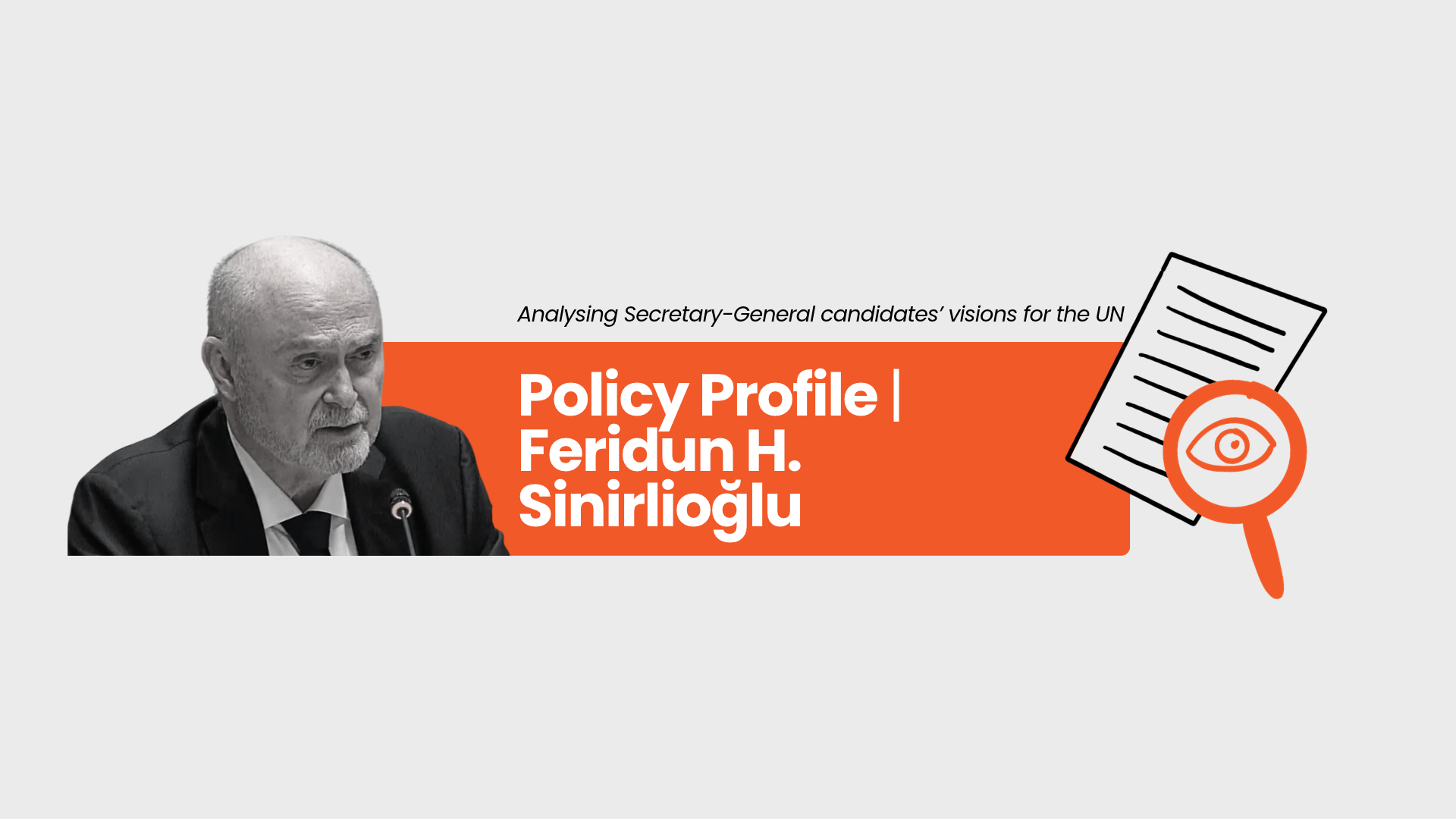
Policy Profile: Feridun H. Sinirlioğlu
-
Center for Human Rights and Policy Studies (CHRIPS) and Saferworld
Summary
Prevention and mediation are pillars of Sinirlioğlu’s vision of an effective Secretary-General. He wants the UN to become a platform for dialogue, with strengthened ties with regional organizations.
Profile
Sinirlioğlu stresses that preventing and resolving conflict must be at the center of the UN’s work. His approach combines early warning, preventive diplomacy, mediation, development, and respect for human rights. He commits to strengthening the Secretary-General’s good offices while ensuring that women, young people, and civil society participate meaningfully included in peace processes.
He believes the UN needs a Secretary-General who is not only a chief administrator, or the voice of the organization, but also an active and experienced diplomatic mediator, prepared to go where peace is most needed. If appointed,he aims to bridge differences, and provide Member States with options for action and consensus. He commits to a more visible presence on the ground, reaching out directly to leaders on opposing sides, taking “calculated risks”, and engaging discreetly – “silent diplomacy is a sine qua non of effective mediation.”
Sinirlioğlu would strengthen ties with regional organizations, citing Chapter 8 of the Charter as the basis for that partnership. He believes that improved cooperation is crucial for prevention capacities, noting the opportunities to benefit from the tools that these regional organizations have in early warning, risk reduction, crisis management, conflict prevention, and arms control. He commits to strengthen structured engagement with civil society, particularly women, young people, and local organizations across early warning, mediation, peacebuilding, and decision-making.
Sinirlioğlu notes that he is dealing with the war in Ukraine on a daily basis, and argues that as Secretary-General he would strengthen the UNs role as a platform for dialogue. When pressed on the conflicts or disputes in which Turkey is a party, he noted that he has proven that he can act as an “international civil servant, in an independent, impartial way.”
He stated that the human rights pillar is “indispensable to achieving peace, security and sustainable development, and vice versa”, committing to use all Charter instruments and to increase the 1% share of UN spending on human rights, which he called the “weakest funded pillar.”
-
Cairo International Center for Conflict Resolution, Peacekeeping, and Peacebuilding (CCCPA) and International Peace Institute (IPI)
Summary
Sinirlioğlu frames peacekeeping as a stabilizing tool requiring continuous reform and emphasizes stronger partnerships with regional organizations under Chapter VIII of the Charter. He engages only briefly with peace operations specifics and has not substantively addressed peacebuilding.
Profile
Sinirlioğlu’s vision statement and dialogue center on conflict prevention and mediation rather than peace operations or peacebuilding. On peacekeeping, his vision statement affirms that “UN peacekeeping operations continue to serve the cause of peace by fostering stability, supporting peace agreements, and protecting civilians.” He adds that they are “not an end in themselves” and “must remain agile, effective, and responsive through continuous review and reform.” He did not elaborate on peacekeeping in his interactive dialogue.
Sinirlioğlu focuses more on partnerships with regional organizations. His vision statement calls for the UN to work with them on the basis of “regional ownership, burden-sharing, and operational sustainability.” In his dialogue, he elaborated that the UN “is not fully using the potential of the regional organizations” and that Chapter VIII of the Charter “should be better used,” including by drawing on their tools for early warning, crisis management, and conflict prevention.
On peacebuilding, Sinirlioğlu has said little. His vision statement mentions it once, listing it as a capacity the UN should strengthen, however, when asked directly during his interactive dialogue how he would strengthen the peacebuilding architecture he did not elaborate. He did state that civil society must be “meaningfully involved” in peacebuilding and that peace “cannot be sustainable unless it is inclusive.”
His most relevant experience is his role as Secretary-General of the Organization for Security and Co-operation in Europe (OSCE), a position he has held since December 2024. From 2023-2024 he also served as UN Special Coordinator for the Security Council–mandated Independent Assessment on Afghanistan, which he says reinforced “the importance of bringing political, humanitarian, and development efforts together.”
-
Summary
Sinirlioğlu commits to local engagement to bring humanitarian together with political and development efforts. He champions measures to support refugees and a two-state solution for Palestine. Questions raised on his diplomatic record regarding his commitment to international law.
Profile
During Sinirlioğlu’s General Assembly dialogue, he noted that conflict, economic vulnerability, climate change and humanitarian crises are complex and interconnected challenges, which are undermining the global sustainable development agenda. In his responses he addressed various humanitarian issues in detail.
On UN reform, Sinirlioğlu would prioritize stronger country-level coordination, measurable results and meaningful engagement with local communities, bringing political, humanitarian and development efforts together. He asserts that cuts alone are not reform, and reform efforts must not undermine essential humanitarian, development and human rights work.
He commits to prioritising Palestine with the goal of achieving a two state solution; he specifically addressed the humanitarian situation, stating “I would work to ensure the protection of civilians, sustained and unhindered humanitarian access, and the effective delivery of assistance. The capacities of UN agencies and humanitarian organizations, including UNRWA, must be preserved, strengthened and, where necessary, reformed so that they can fulfil their respective mandates.”
Sinirlioğlu acknowledges the importance of meeting humanitarian needs, and believes the international community must strengthen refugee ‘burden sharing’ and provide more predictable financial support to countries hosting large numbers of refugees. He has committed to working closely with UNHCR, host countries and countries of origin to ensure refugee returns are sustainable, noting repatriation must always be voluntary, safe and dignified and in line with UN principles and international law. He has highlighted the need for conflict prevention and early intervention, and repeatedly emphasized the importance of regional organisations.
On multiple occasions Sinirlioğlu pledged his support for international law and the UN Charter. However, as a former diplomat representing Türkiye, Sinirlioğlu was taken to task on his record by several states, including Greece, Cyprus and Israel. The interventions questioned his commitment to international law, respect for territorial integrity among other issues. Sinirlioğlu responded by saying he has been nominated by his country but is not acting as a representative of it, mentioning that he has “proven several times that I can be an impartial, independent international civil servant”.
One of Sinirlioğlu’s previous roles with relevance to humanitarian action was his time as UN Special Coordinator for the Independent Assessment on Afghanistan from from 2023-2024.
-
Center for Policy Dialogue (CPD) and Southern Voice
Summary
Sinirlioğlu advocates for sustainable development, youth employment and equal attention to the UN’s three pillars. He emphasises institutional effectiveness, gender and geographical representation, and stronger regional cooperation, but offers limited detail on implementation.
Profile
Sinirlioğlu identifies “accelerating sustainable development and climate action” as one of his five priorities for the UN. He views the UN’s three pillars of peace and security, development, and human rights as interconnected and equally important.
On sustainable development, Sinirlioğlu recognises the 2030 Agenda as a major achievement but expressed concern that only 36 per cent of assessable SDG targets are on track or making sufficient progress. He mentioned addressing systemic challenges faced by vulnerable populations and stressed the importance of greater representation of all voices, however, he did not respond in detail to Global South demands for greater influence over global decision-making power.
On development financing, Sinirlioğlu highlighted that the global sustainable development financing gap exceeds $4 trillion annually, with the shortfall disproportionately affecting developing countries. He calls for international financial mechanisms to be better aligned with development priorities while committing to work with Member States to strengthen the UN’s development pillar.
Sinirlioğlu also focuses on youth employment. He proposes a global jobs agenda involving the ILO, UNDP, World Bank and other partners, supported by measurable targets. Priorities included skills development, entrepreneurship, digital transformation and investment in labour-intensive sectors, particularly to create opportunities for young people and women.
On gender representation, he offered broad support for women’s empowerment, gender balance in senior UN appointments and greater geographical diversity within the Secretariat without outlining specific targets.
Overall, Sinirlioğlu emphasised diplomacy and multilateral cooperation but provided limited implementation details. Although he acknowledged AI’s growing importance, he offered no specific detail on how inequality could be safeguarded or on the risks and opportunities for development.
-
Center for Justice and International Law (CEJIL) and GQUAL Campaign
Summary
Links human rights to peace and development, calling for increased funding and preventive diplomacy. Pledges gender balance in UN appointments without mentioning specific targets. Offers limited detail on strengthening human rights bodies and advancing accountability.
Profile
Sinirlioğlu pledges to act as an “independent guardian” of the Charter, upholding its principles without political selectivity or double standards. He identified human rights among his five priorities, stressing their indivisibility from peace, security and sustainable development.
He centered conflict prevention, emphasizing early warning, preventive diplomacy and mediation. Supporting UN80, he cautioned that “cuts alone are not reform” and must not undermine humanitarian, development or human rights work. He called for a stronger, better-funded human rights pillar, without explaining how to achieve it or proposing ways to strengthen its bodies or accountability mechanisms.
Sinirlioğlu said impartiality “must never mean indifference” and pledged to use UN human rights instruments while respecting State sovereignty, expressing a preference for discreet diplomacy. He described accountability as essential to sustainable peace and supported impartial, independent and credible investigations, but left unanswered the question of how good offices could advance accountability when a permanent Security Council member is implicated.
Asked whether he shared the Committee against Torture’s concerns about alleged widespread torture in Türkiye or if he supported independent investigations, Sinirlioğlu did not respond. Nor did he address OHCHR’s assessment that blanket bans on demonstrations imposed by Türkiye were unlawful, or whether he would publicly defend expression and peaceful assembly. His response left unclear how he would engage with human rights bodies’ assessments, at least those concerning his own country.
On gender equality, he prioritized women’s empowerment, combating violence and meaningful participation in decision-making, but did not explain how he would counter the normative attacks on women’s and girls’ rights raised during the dialogue. He pledged to prioritize gender balance in all appointments, especially at senior levels, but specified no parity target and did not answer a question about his leadership appointments, including gender and regional considerations relating to the Deputy Secretary-General.
Sinirlioğlu said civil society should help shape decisions, particularly on early warning, mediation and peacebuilding.
-
CIVICUS and Transparency, Accountability and Participation (TAP) Network
Summary
Sinirlioğlu pledges gender balance in appointments and structured civil society engagement. He champions a global jobs agenda for young people but little on participation in shaping norms. He offers little detail on championing human rights defenders if discreet diplomacy fails.
Profile
Sinirlioğlu’s vision centres on strengthening the UN’s capacity to mediate disputes and prevent conflict, working with women, young people and civil society. He commits to observing gender balance “across-the-board” in all appointments as Secretary-General, remarking that gender equality, women’s empowerment and combating violence against women should be a top UN priority. He highlights his record on improving women’s representation, including raising the proportion of women in the OSCE workforce to over 55 per cent under his leadership. Sinirlioğlu was less specific when asked about the backlash against the rights of women and girls – he mentioned that the 1 per cent share of UN spending on human rights must rise but did not offer targets or concrete next steps.
On youth, his vision statement places young people at the heart of the 2030 Agenda and stresses their meaningful participation in decision-making. In his dialogue, he proposed a coordinated global jobs agenda with the ILO, UNDP and World Bank, focused on skills, entrepreneurship and digital transformation. On participation, he said campaigns should help young people “own” the UN – however, he offered little detail on how this might work in practice or how young people can contribute to decision-making on global norms.
Sinirlioğlu affirms that civil society must be involved in shaping decisions rather than consulted afterwards, and pledges structured engagement with women, young people and local organisations, including in early warning and mediation. Elaborating on this, he drew on his experience leading consultations with Afghan civil society representatives whilst working as UN Special Coordinator for the Security Council–mandated Independent Assessment on Afghanistan from 2023-2024. When questioned on the need to build capacity of Global South organisations in the least developed states and conflict zones his response was short on detail. When asked about how he would handle powerful states violating human rights and how he would protect civil society and affected communities, he favoured “discreet” and “preventative” diplomacy without setting out what he would do if that approach fails.
-
Plataforma CIPÓ and SHE Changes Climate
Summary
Sinirlioğlu mentions climate change only briefly, as one of several pressures on sustainable development. He calls for reforming the international financial architecture to close the development financing gap without linking his proposals to climate finance.
Profile
In the main, Sinirlioğlu addresses climate change in passing, as one of several pressures on sustainable development. In his opening remarks to the General Assembly, he listed “accelerating sustainable development and climate action” among five priorities, but went on to elaborate on other issues such as conflict prevention, confidence in multilateralism, and UN reform without offering further information on climate. Addressing a question from the Group of 77 and China, he identified climate change alongside armed conflict, economic vulnerabilities and humanitarian crises as factors that “increasingly undermine the global sustainable development agenda,” and called for “scaled up investment, renewed commitment and concrete implementation” before 2030. Sinirlioğlu did not mention the COP climate summit during his remarks.
The “Accelerating sustainable development and climate action” section of his Vision Statement describes the SDGs as “humanity’s shared blueprint for a more just, inclusive, and resilient future”. Under this heading, “protecting the environment and biodiversity” is listed among the efforts needed to reduce inequalities, which he considers essential to lasting peace and stability. The section does not address climate change directly.
He calls for a stronger focus on the structural challenges facing least developed countries, landlocked developing countries and small island developing states. He presents support for these countries as “not only a moral responsibility, but a strategic investment in global peace, stability and prosperity.”
Sinirlioğlu’s development agenda links progress on the SDGs to “innovative financing” and “practical support for countries facing the greatest vulnerabilities.” During his dialogue, he pointed to a development financing gap of more than $4 trillion a year, falling disproportionately on developing countries. He noted growing calls for reform of the international financial architecture, asserting that international financial mechanisms “must be aligned with development priorities.” He frames these proposals as development measures and does not link them to climate finance.
-
Summary
Ambitious reform lacking. Sinirlioğlu believes member states should steer reform. Peace and security a priority, discreet diplomacy preferred to public statements.
Profile
Sinirlioğlu notes reform is essential to rebuild trust in the UN. A reform agenda is absent, however.
He recognises that there is “momentum” behind reform although he believes that member states shape UN reform. He does envision the Secretary-General facilitating and providing benchmarks for member states to follow during discussions.
Sinirlioğlu supports UN80 but notes that the process should also entail rationalisation of agencies and not just cuts. He emphasises greater accountability for delivery.
He focuses on peace and security and emphasizes bringing adversaries together. In this regard, he refers to his experience in mediation as Secretary-General of the Organization of Security Cooperation in Europe .
He believes the UN “should strengthen its capacities for early warning, mediation, [and] peacebuilding”. Peacekeeping mandates need to be “responsive through continuous review and reform” for Sinirlioğlu.
Sinirlioğlu strongly advocates for upholding the UN Charter, with a preference for “discreet” diplomacy and early-engagement to prevent violations of international law from occurring. He acknowledges positions he takes as Secretary-General may differ from the positions he has taken as a Turkish foreign minister and UN representative in the past.
He calls for the funding for the UN’s human rights work to be increased and believes the UN should play a role in artificial intelligence, biotechnology, and cybersecurity. He sees a greater role for regional bodies and calls for renewing international cooperation to deliver the Sustainable Development Goals.