
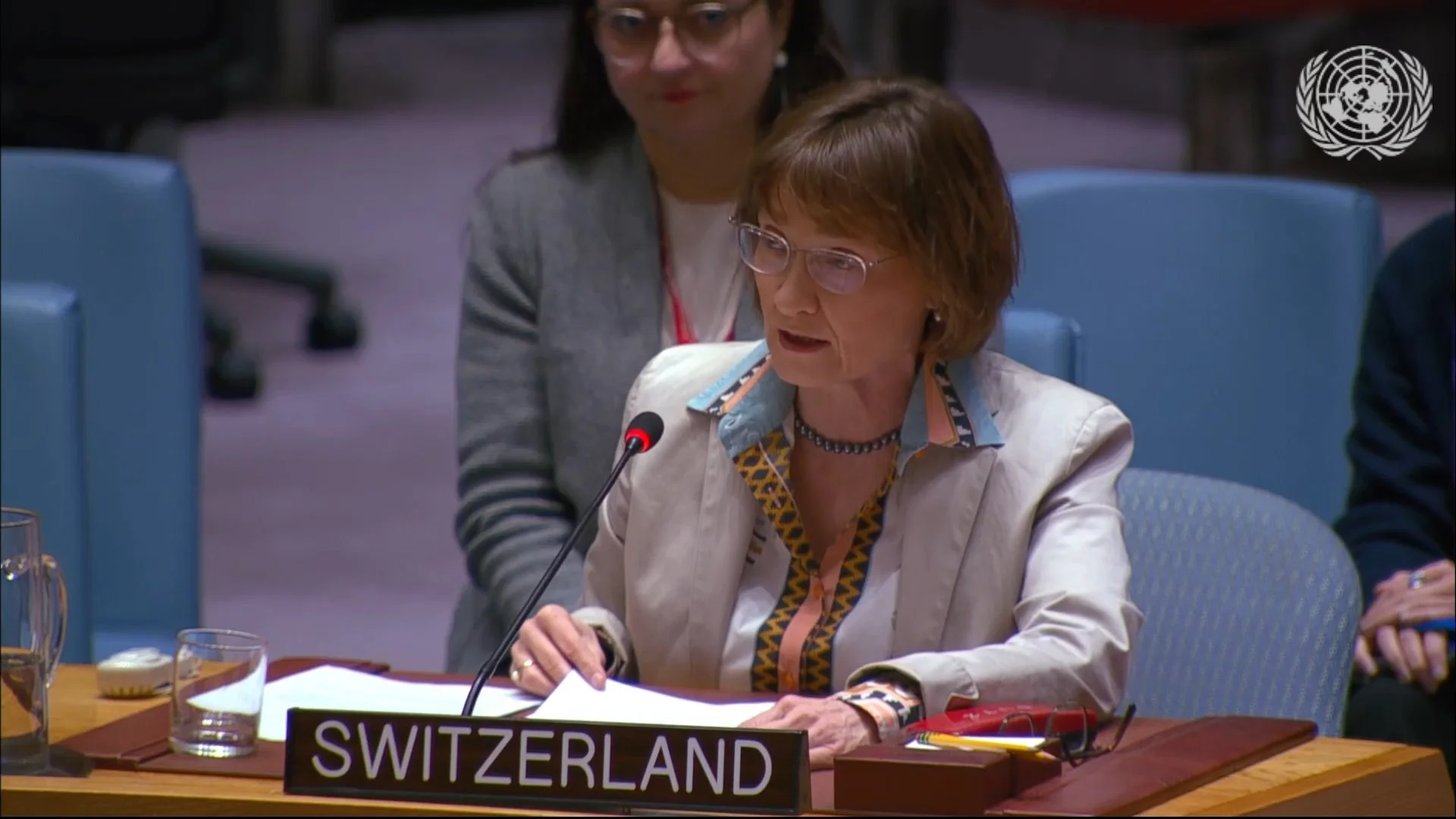
On 15 December the Security Council held an open debate on “Leadership for Peace” under the presidency of Slovenia, building on a similar debate held by Slovenia in 2024. Ahead of the debate, Slovenian Permanent Representative, Ambassador Samuel Žbogar, underscored that the discussion will focus on the upcoming selection of the UN Secretary-General, noting that the session offers all Member States an opportunity to share their views on “what kind of Secretary-General the UN of the future needs.”
Ambassador Žbogar also invited Member States to use the debate to reflect on “what type of role the UN needs in this challenging time,” emphasizing the importance of articulating the competencies, independence, and leadership profile required to steer the Organization effectively.
Setting the scene, Mr Žbogar highlighted the extraordinary breadth of the role, describing it as simultaneously the manager of the Secretariat, the overseer of peacekeeping operations, a peacekeeper and conflict preventer, a moral authority, and a guardian of the Charter.
During the debate over 70 states spoke as well as groups of states including ACT and the EU. Two external guests also delivered briefings: former Secretary-General Mr Ban Ki-moon in his role as an Elder Emeritus and Ms Dayal, Associate Professor of International Politics, Fordham University. 1 for 8 Billion requested the opportunity to speak in this debate but the request was not successful.
Ahead of the debate 1 for 8 Billion circulated a primer outlining the formal requirements for the role along with a person specification based on these requirements.
States vocal about the need for a woman SG
A significant number of delegations, including Security-Council states: Denmark, France, Greece, Guyana, Slovenia and the UK, promoted the need to appoint a woman to the post, stressing the inconsistency of the fact that, after 80 years, the UN has never had a woman Secretary-General.
A slew of non-Council members also highlighted the issue. Estonia put it simply: “It is time for a female Secretary-General. After 80 years of men-only leadership, the argument that a fair and merit-based selection process somehow leads to a man again, is not holding up anymore”, while Brazil said “There has never been a woman leading this organization; the time is more than right for that” while the UAE said it hopes “to see a large pool of candidates, half of whom are women, thereby increasing the chance that perhaps, finally, we will be able to welcome the first Madame Secretary-General”.
Many calls were grounded in both principle and pragmatism. Ireland remarked “Appointing a woman as Secretary-General is not about symbolism, but about fairness and credibility. Structural barriers that prevent women from fully realising their leadership potential must be addressed. Women can no longer be held to a different or higher standard” while Slovenia argued that a female Secretary-General is “not just about symbolism, it is about credibility”. Germany anchored its support in the recently agreed Pact for the Future, stating, “It is regrettable that there has never been a woman Secretary General,” and emphasized that this goal is “no contradiction to a merit-based process.”
Chile’s delegate remarked: “A woman Secretary-General will bring indispensable experiences and perspectives of women worldwide, strengthen the legitimacy, effectiveness and inclusive vision to lead the multilateral system”. Chile’s statement did not refer to its previous announcement of its intention to nominate Michele Bachelet as a candidate - a plan on which commentators have cast doubt following recent domestic elections in Chile.
Recent research conducted by New York University’s Center for Global Affairs and the Global Network of Women Peacebuilders (GNWP) in partnership with 1 for 8 Billion show that at least 94 states appear intent on appointing the UN’s first-ever Madame Secretary-General. While this number has grown in the last year, the outcome is far from a done deal. The permanent members of the Security Council, who have an outsized influence on the selection, have a range of positions on this issue. See this recent article for Just Security, co-written by 1 for 8 Billion advisor Ben Donaldson, for analysis on Security Council dynamics on this issue.
Calls for transparency, inclusivity and a more active General Assembly
Several delegations emphasized the need for the General Assembly to play a more decisive and substantive role in the selection process, reflecting the role assigned to the Assembly by the UN Charter.
Multiple states proposed more transparent and structured ways for the General Assembly to express its preferences during the selection process. The ACT Group suggested the use of advisory votes or other quantifiable mechanisms in the General Assembly, to allow the Assembly to signal its preferences clearly while also advocating for the Security Council to recommend more than one candidate for the General Assembly’s consideration.
Germany called for a process where the entire membership has a meaningful say while the EU expressed its hope for more inclusivity and transparency in the upcoming selection process. Multiple states including the ACT Group, Estonia and Slovenia highlighted the importance of full transparency around any Security Council straw polls —including their timing and results—so that the wider membership can understand how the Council’s views are forming.
Ireland remarked: “The selection must be transparent, inclusive and credible, or the successful candidate risks beginning their term without the full confidence of the wider membership.”
Former Secretary-General Ban Ki-moon noted the potential for the General Assembly to assert itself with respect to the tenure of the next Secretary-General, arguing for a single term of office to strengthen the independence of the office-holder: “The next Secretary-General should be empowered by a single, seven-year term. Two five-year terms leave the Secretary-General overly dependent on this Council’s Permanent Members for an extension. This is a convention, not a Charter requirement, and the General Assembly holds the power to set the terms of the appointment itself.”
1 for 8 Billion welcomes proposals for increased transparency, inclusivity and accountability as vital measures to enhance trust and accountability and to discourage back‑room deals between candidates and powerful countries.
Regional representation
Many states including the ACT Group, Brazil, Bulgaria, Costa Rica, Greece, Ireland and Uruguay raised the importance of regional considerations when selecting the next UN Secretary-General, often linking their calls to the need for improved gender representation in the UN’s top job.
Bulgaria remarked that, in 80 years, neither a woman nor a representative of the Eastern European Group has ever held the post of Secretary-General. Brazil and Uruguay made similar points in relation to their own region, with Uruguay stating it is time for both the Latin American and Caribbean region and a woman to assume the role of Secretary-General, while Brazil remarked that the next Secretary-General should be from Latin America, “preferably a woman”.
Civil society inclusion
The value of civil society involvement in the selection process was recognised by a number of delegations. The ACT Group, Estonia, and Germany stressed that civil society should be integrated into the upcoming open dialogues with candidates and to ensure these hearings provide richer opportunities for interactivity. 1 for 8 Billion has previously suggested improved modalities for hearings, including thematic debates and the provision follow-up questions to participants, and will be releasing further information on this topic in 2026.
Germany recalled that the 2016 candidate hearings demonstrated how such dialogues can positively transform the process while Estonia added that civil society participation is critical for a full assessment of candidates against the full spectrum of required criteria. The ACT Group asked for early notice regarding arrangements for the GA hearings.
Requirements for an effective Secretary-General
Many states used the debate to outline the competencies, experience, and personal qualities they believe the next Secretary‑General should possess. These reflections closely align with the comprehensive framework presented in the resources shared with Member States ahead of the debate.
A large number of delegations including Brazil, Costa Rica, Estonia, Germany, Portugal and Slovenia emphasized the need for a candidate with proven leadership in international relations, high moral authority, independence, integrity, and a firm commitment to the UN’s three pillars—peace and security, human rights, and sustainable development.
Security Council state Somalia highlighted the need for the next Secretary-General to go beyond administrative competence, remarking that “we must prioritize independence and moral courage,” while Ukraine promoted the need for the next Secretary-General to defend the Charter, speak with courage and act when needed, recalling Dag Hammarskjöld’s legacy and welcoming António Guterres’ role in the Black Sea Grain Initiative.
Specific skills widely highlighted included mediation and negotiation abilities, managerial experience, diplomatic courage, communication skills, and a commitment to reform, inclusivity, and accountability. A large number of delegations mentioned the need for the next Secretary-General to embody the core values of the UN and communicate their commitment to the three pillars of the UN’s programme.
1 for 8 Billion’s primer for the debate goes into detail regarding the formal requirements and competencies for the role and provides a person specification based on these criteria.
Multiple P5 states argue for a narrower UN
Amid the broader calls for a transformative Secretary‑General, some permanent Security Council members expressed a vision of a more constrained UN role re-focused around a more limited reading of the UN Charter.
The United States stressed that the next Secretary‑General must “bring the UN back to the purposes and principles of the UN Charter,” ensuring the Organization serves Member States, respects sovereignty, guarantees fiscal responsibility, and cuts wasteful spending. Russia similarly emphasized that the UN should return to its basic Charter functions while the United Kingdom also called for a UN “refocused on its core priorities,” notably peace and security, humanitarian and development assistance, and human rights.
These positions contrast with wider appeals for an inclusive, proactive Secretary‑General capable of addressing interconnected global challenges that reinforce the UN’s peace and security mandate.
Resources
See here for the UN Web TV recording of the event
See here for our resource on the formal requirements and selection criteria for the role
See here for our candidates and speculation page
See here for our tracker following member states’ commitment to a woman SG, in partnership with NYU’s Center for Global Affairs and the Global Network of Women Peacebuilders (GNWP)
Image: Pascale Baeriswyl, Permanent Representative of Switzerland delivers statement on behalf of members of the Accountability, Coherence and Transparency (ACT) Group