
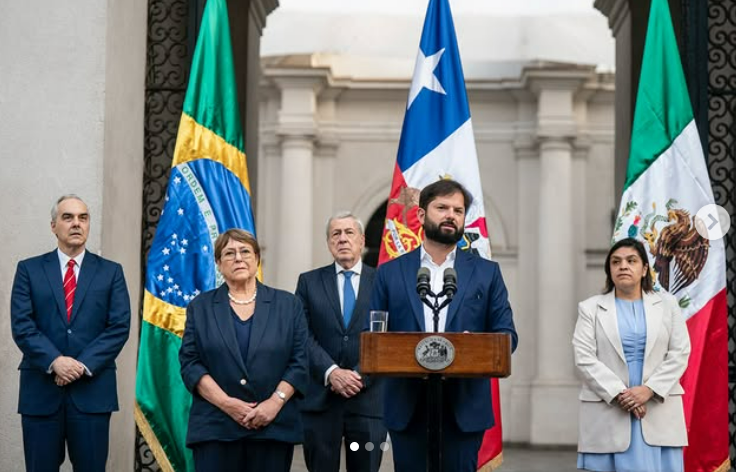
On 24 March Chile announced that it is withdrawing its support for Secretary-General candidate Michelle Bachelet, a candidate Chile nominated together with Brazil and Mexico on 2 February.
Bachelet’s entrance as a candidate broke new ground as the first (and thus far, only) candidate nominated by multiple states in the modern era, making use of new rules governing the selection process. Likewise, Chile’s move marks the first time a nominating state has withdrawn its support for a candidate.
Multiple General Assembly resolutions adopted in recent years make it clear that for a nomination to be viable it must be supported by “at least one Member State” (see Resolutions 75/325 and 77/335). The most recent resolution on the matter reinforces this, stating that a candidate “should be nominated by one Member State or by a group of Member States” (79/327)
Consistent with those reforms, the joint letter from the President of the General Assembly and the President of the Security Council launching the current selection process specified that candidates may be nominated “by one Member State or by a group of Member States”. It also clarified that each Member State may nominate only one candidate, either individually or jointly with others.
While the rules on candidate withdrawals state that “a nominating Member State may withdraw a candidate at any time during the process”, in the case of a jointly nominated candidate, successive resolutions make it clear that a candidacy remains viable while the nomination retains the backing of “at least one Member State”.
This being the case Bachelet’s candidacy remains intact since her nomination retains the support of two nominating states: Brazil and Mexico.
Joint nominations were introduced to allow broader sponsorship and to reduce influence or the perception of influence through patronage to a single state. It is clear the nomination route is now playing an important role by insulating the viability of a candidacy from the vagaries of their domestic political landscape.
Recent statements from Chile, which swore in its new President earlier this month, indicated that it will not support any other candidate as long as Bachelet remains in the race. Implicit in this statement is the understanding that Bachelet will continue as a candidate with Brazil and Mexico’s continued support. Bachelet herself issued a public statement declaring that her “willingness to contribute to this challenge remains intact” while confirming she “will continue to work closely with the governments of Brazil and Mexico”.
As joint nominations potentially become more common, this development demonstrates the importance of the reforms to nominations that 1 for 8 Billion has successfully advocated for over the years, in support of greater independence and a fairer process.
Photo: Former President of Chile, Gabriel Boric announces Michelle Bachelet’s candidacy for Secretary-General, accompanied by Michelle Bachelet, former Foreign Affairs Minister Alberto van Klaveren, and the ambassadors of Mexico, Laura Moreno, and Brazil, Paulo Pacheco. February 2026.